Evolution: An Ancient Lineage with an Indian Connection
The honey badger is not a recently evolved oddity. The fossil history of Mellivora reaches very deep into the Neogene era, with some extinct relatives appearing several millions of years ago. The fossils of this genus have been found all across Africa and Eurasia, documenting a much older history than what the distribution of the modern animal suggests.
India has an interesting place in this story. Fossil evidence has been used to link the evolution of the Mellivora lineage with older mellivorine mustelids from the Indian subcontinent. The extinct Promellivora punjabiensis has been discussed as a primitive relative in the history of Mellivora, which makes the honey badger more than an African animal that occurs in India.
A Timeline of the Evolution
| Timeline | Evolutionary development |
| 50 million years ago | Early carnivorous species evolved and gave rise to groups related to modern carnivores |
| 30-20 million years ago | The mustelid family (weasels, otters, badgers, and other related animals) began diversifying |
| 20-10 million years ago | The lineage leading to honey badger became distinct around this time |
| 10-5 million years ago | Early members of the Mellivora genus started appearing and developed adaptations for digging and a carnivorous/omnivorous diet |
| 5 million years ago-present | The honey badger evolved its characteristics, strong jaws, loose skin, powerful claws, etc |
| Present day | Modern honey badgers are found widely in Africa, the Middle East, and South Asia, including India |
Where Do Honey Badgers Live?
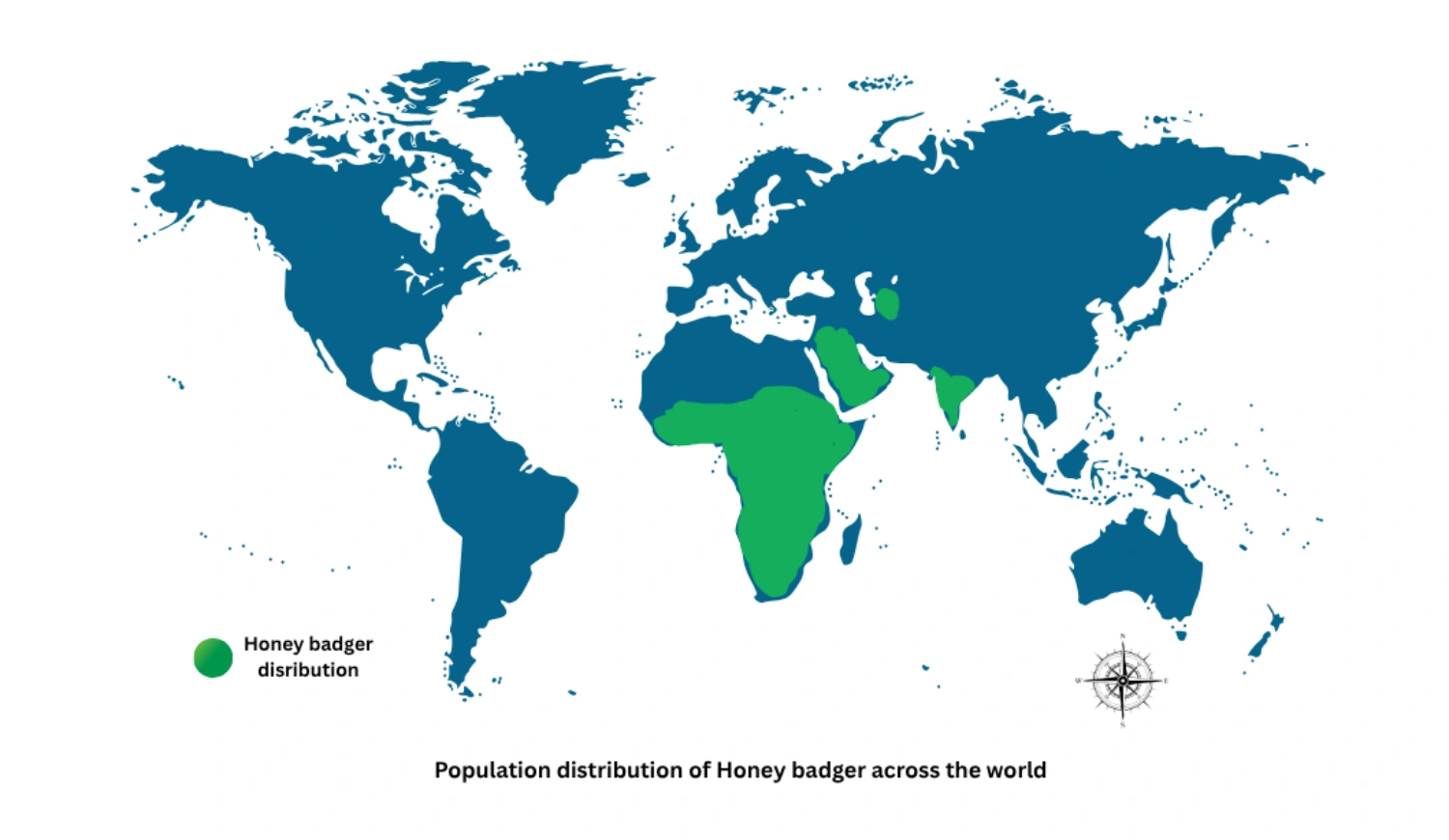
Distribution: Honey badgers are known to be highly adaptable, and their global range stretches across much of Africa and Asia, including the Indian subcontinent. In India, the honey badger has been recorded in the states of Madhya Pradesh, Maharashtra, Gujarat, Rajasthan, Uttarakhand, Karnataka and Odisha.
Habitat: Honey badgers are highly adaptable, and they have been seen adapting to different kinds of habitats such as:
- Dry deciduous forests
- Scrub and thorny vegetation
- Grasslands
- Semi-arid regions
- Rocky terrain
Research Study in Maharashtra’s Tadoba Andhari Tiger Reserve
Let’s have a look at a recent modern study in Maharashtra’s Tadoba Andhari Tiger Reserve India to understand the distribution and population of honey badgers.
A research study conducted in this forest used around 397 camera-trap locations and accumulated 9,828 trap nights. The study obtained 206 honey badger captures from 102 camera traps. In this study, the honey badger showed a very positive association with forest cover and a negative association with elevation. This study was important because of the stereotypical association of the honey badger with the dry savannah of Africa. India tells us something different: it is not a desert specialist, it is a highly adaptive carnivore capable of living in forest landscapes as well.
Feeding Behaviour: What Do Honey Badgers Eat?
Honey badgers are predators that will eat almost anything; they are generalists. Although the name suggests that they eat honey, that’s not the only thing they consume. They feed on rodents, snakes, birds, eggs, insects, larvae, carrion and anything that is available. This broad diet helps them adapt to different environments, allowing them to occupy a huge geographic range.
Defence Mechanism: How Does It Defend Itself?
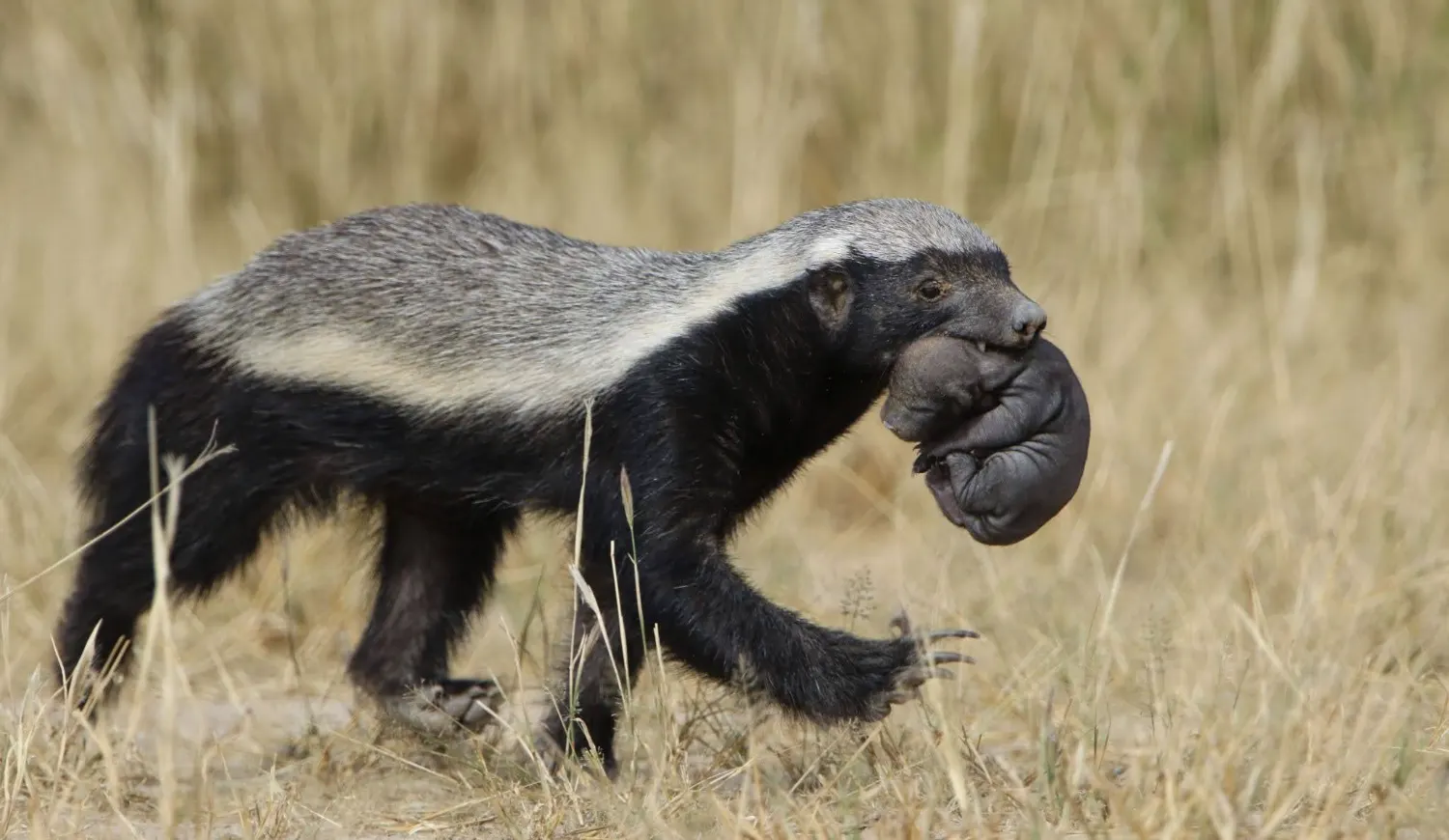
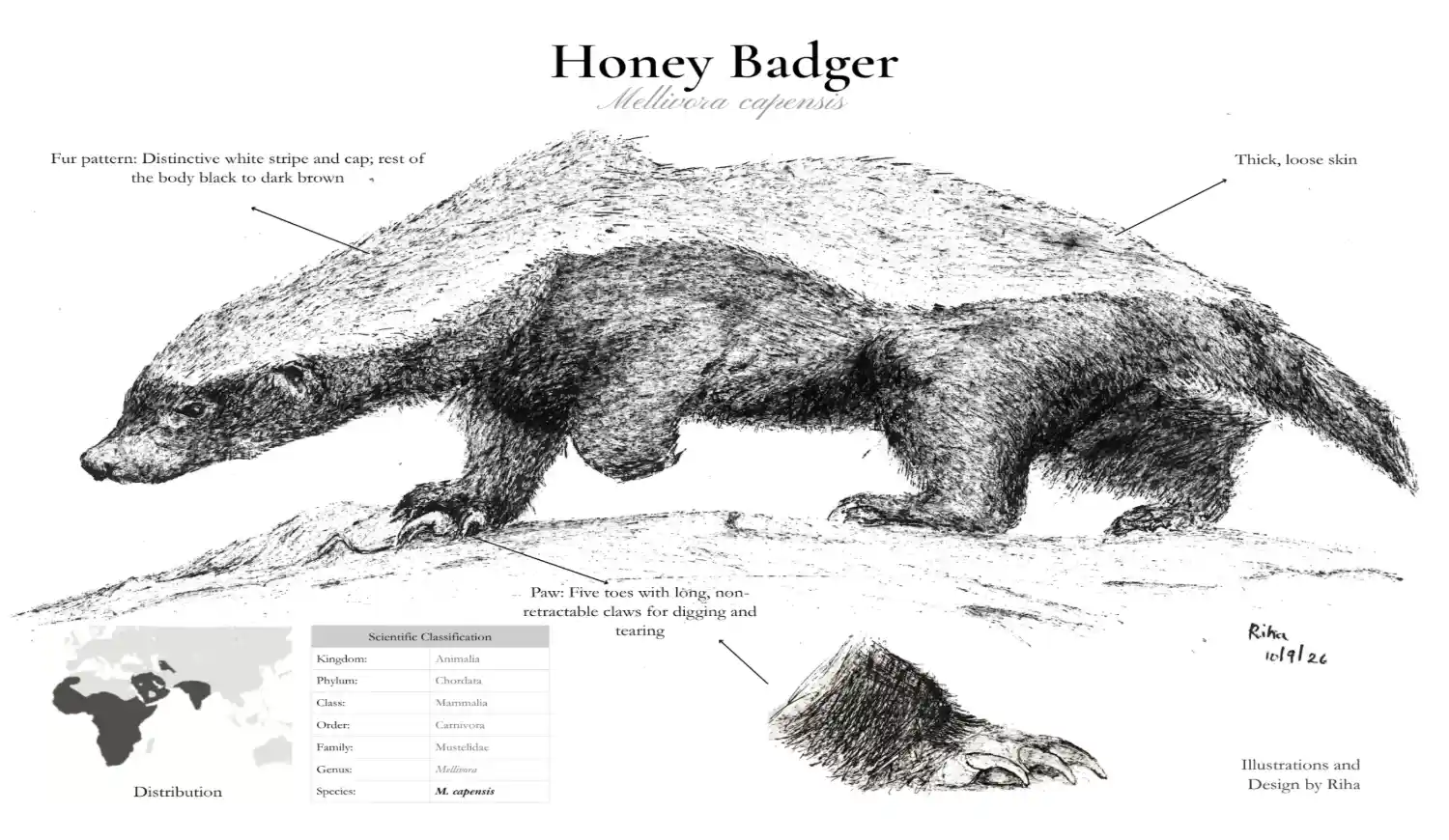
One of the most repeated honey badger myths is that it has extremely thick fur — it doesn’t. It has a highly remarkable protective feature, which is its skin.
Honey badgers have unusually thick and loose skin; it’s not the fur that makes it so unbeatable. The looseness of the skin is very crucial, since it gives the badger considerable freedom of movement even when another animal has grabbed it.
Sharp Claws
The honey badger has long, sharp, powerful claws, especially on its front feet. These claws are very useful in digging burrows and breaking open beehives, defending itself against predators, and scratching and attacking opponents when threatened.
Strong Jaws and Teeth
The honey badger has a very powerful bite and sharp teeth. When threatened, it can bite a predator with a considerable amount of force. The combination of strong claws, jaws and teeth can be risky for the predator.
Snake Venom Resistance
Honey badgers are known to prey on snakes, and they often encounter them. Just like some species of mongoose in India, honey badgers are partially immune to venom — it is not complete resistance. Some studies conclude certain neurological adaptations in them reduce the effects of neurotoxins; however, a heavy dose of venom can still be just as dangerous and pose a threat to their life. Interestingly, sometimes when a honey badger is envenomated, it becomes temporarily incapacitated and recovers after some time.
Chemical Defence
Honey badgers possess anal scent glands that can produce a very strong-smelling secretion. When threatened, they can release this odour, which discourages a predator from further attack.
Mating Behaviour of Honey Badger
Since honey badgers are solitary beings, they only come together for reproduction. Honey badgers don’t necessarily have a mating season; it can happen year-round depending on favourable factors.
Courtship
The honey badger has long, sharp, powerful claws, especially on its front feet. These claws are very useful in digging burrows and breaking open beehives, defending itself against predators, and scratching and attacking opponents when threatened.
Mating
The honey badger has a very powerful bite and sharp teeth. When threatened, it can bite a predator with a considerable amount of force. The combination of strong claws, jaws and teeth can be risky for the predator.
Delayed Implantation
Honey badgers are known to prey on snakes, and they often encounter them. Just like some species of mongoose in India, honey badgers are partially immune to venom — it is not complete resistance. Some studies conclude certain neurological adaptations in them reduce the effects of neurotoxins; however, a heavy dose of venom can still be just as dangerous and pose a threat to their life. Interestingly, sometimes when a honey badger is envenomated, it becomes temporarily incapacitated and recovers after some time.
Maternal Care
Honey badgers possess anal scent glands that can produce a very strong-smelling secretion. When threatened, they can release this odour, which discourages a predator from further attack.
The Mystery of India’s Population: Threats and Conservation Measures
Although, in India, the honey badger is listed under Schedule-1 of the Wildlife Protection Act — providing it the country’s highest level of protection under the current wildlife structure — globally this species has been assessed as ‘Least Concern‘ because of its enormous distribution and ecological adaptability. But these two facts can exist simultaneously, because these global records also talk about the population decline and the threats the species is currently facing.
| Threats | Conservation Measures |
| Habitat loss due to agriculture, urbanisation and development | Protect and restore natural habitats. |
| Habitat fragmentation by roads and infrastructure | Maintain wildlife corridors and habitat connectivity. |
| Road accidents and vehicle collisions | Install wildlife crossings and reduce vehicle speeds in wildlife areas. |
| Human-wildlife conflict | Promote community awareness and coexistence programmes. |
| Illegal hunting and killing | Enforce wildlife-protection laws and strengthen anti-poaching measures. |
| Destruction of burrows and shelter sites | Protect burrows, rocky areas, fallen logs and dense vegetation. |
| Lack of information about populations and distribution in India | Conduct surveys, camera trapping, and long-term monitoring. |
| Lack of public awareness | Educate local communities about the species and its ecological importance. |
References
-
- C.M. Begg, K.S. Begg, J.T. Du Toit, M.G.L. Mills,Scent-marking behaviour of the honey badger, Mellivora capensis (Mustelidae), in the southern Kalahari,Animal Behaviour,
-
- Chatterjee N, Nigam P and Habib B (2020) Population Estimate, Habitat-Use and Activity Patterns of the Honey Badger in a Dry-Deciduous Forest of Central India. Front. Ecol. Evol. 8:585256. doi: 10.3389/fevo.2020.585256
-
- Guo D, Huang H. Multi-Strategy Honey Badger Algorithm for Global Optimization. Biomimetics (Basel). 2025 Sep 2;10(9):581. doi: 10.3390/biomimetics10090581. PMID: 41002816; PMCID: PMC12467031.
-
- Begg CM, Begg KS, Du Toit JT, Mills MGL. Sexual and seasonal variation in the diet and foraging behaviour of a sexually dimorphic carnivore, the honey badger (Mellivora capensis). Journal of Zoology. 2003;260(3):301-316. doi:10.1017/S0952836903003789
-
- Begg, C. M., et al. “Sexual and seasonal variation in the diet and foraging behaviour of a sexually dimorphic carnivore, the honey badger (Mellivora capensis).” Journal of Zoology 260.3 (2003): 301-316.
-
- Gil-Sánchez, Jose María, et al. “Feeding specialization of honey badgers in the Sahara Desert: a trial of life in a hard environment.” Diversity 12.2 (2020): 59.
Frequently Asked Questions
1. Are honey badgers dangerous to humans?
2. Honey badger vs mongoose — which is stronger?
3. Best places to see the honey badger in India
4. What is a honey badger called in India / Hindi?

Written by Shaik Shaheen, Naturalist at Pugdundee Safaris
About the Author: She majored in Master’s in wildlife conservation from Pune in 2021. Having lived in the city her entire life, she would always find her escape in the outskirts of the city of Hyderabad, and she was effortlessly drawn towards wildlife as a career. While she was pursuing her bachelor’s in Genetics and Microbiology, she worked at Hyderabad zoo as a volunteer on the weekends.