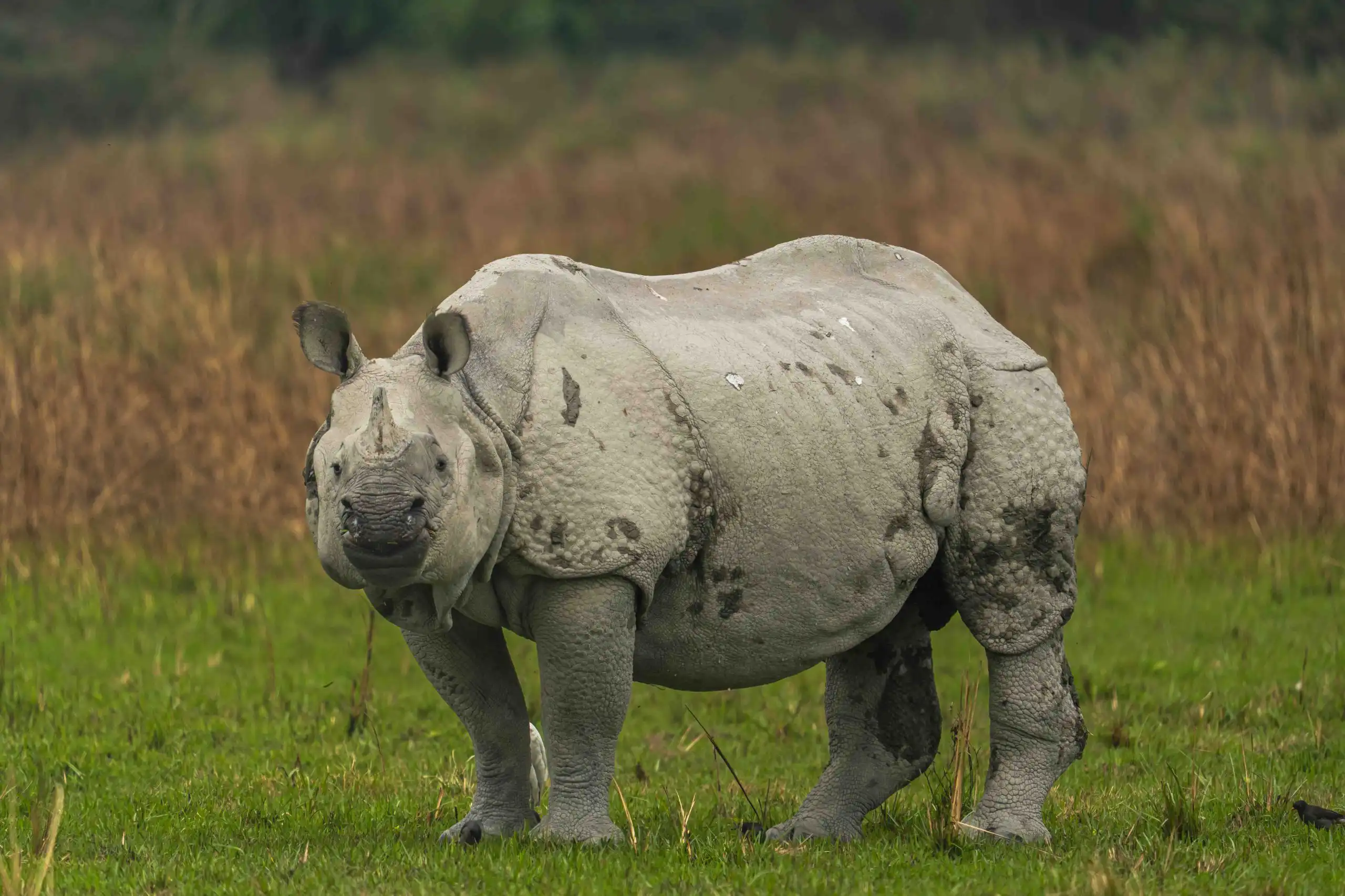
The living reminder from the primordial era appears in the foggy, misty, grasslands of Northeast India. A huge, grey figure with the skin as thick as the plate mail of a knight, moves with an unexpectedly delicate grace. The Greater One Horned Rhino (Rhinoceros unicornis), commonly referred to as Rhino is more than just an animal, it is a symbol of resilience, a keystone of its environment, and one of India’s most well-known conservation success stories.
To come across one in the wild is like getting transported back in time, to see a creature that has walked the world for millions of years, surviving ice ages and the extreme push of human civilizations.
This blog on Rhino is a voyage through the world of this amazing pachyderm. We will look at its biology, its ancient habitat, the heroic efforts that brought it back from the brink of extinction, and how it will be protected for future generations.
What Is the Evolutionary Journey of the Greater One Horned Rhinoceros Like ?
The rhino’s lineage begins not with giants, but with small, tapir-like ancestors like Hyrachyus that browsed the Eocene ( 56 million years ago) forests. The true “Golden Age” of rhinos came during the Oligocene ( 34 million years ago) and Miocene epochs ( 23 to 5 million years ago), when they diverged into an astonishing array of forms.
They were not just ruling Asia but the entire globe. This period saw the rise of the largest land mammal ever to walk the Earth, the truly colossal, long-necked Paraceratherium ( the hornless beast) as well as agile long legged runners and semi-aquatic species.
The dramatic cooling and drying of the global climate acted as a great filter. As forests receded, most of these incredible rhino lineages went extinct. Only those adapted to the new world of grasslands survived into the Pleistocene (2.3 million years ago to 11,700 years ago).
It was during this ice age that the direct ancestor of our modern species, Rhinoceros unicornis, emerged in the floodplains of the Indian subcontinent.
Where Do the Greater One Horned Rhinoceros Live?
From Empire to refuge: The greater one horned rhino was not a rare species to begin with, confined to the northeast of India and Nepal, its empire was very vast.
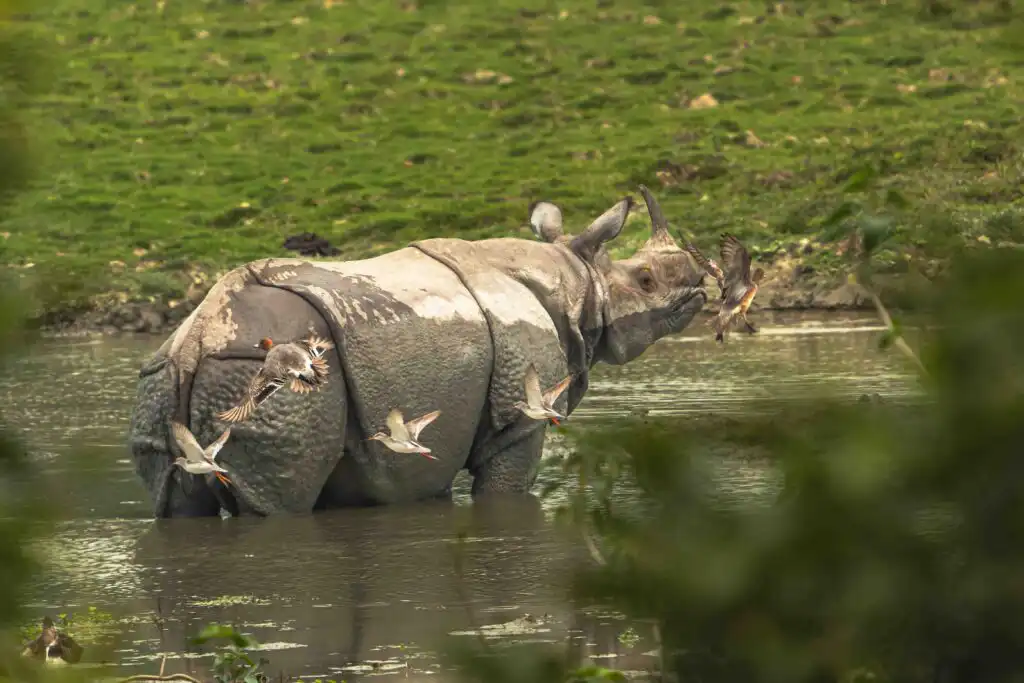
Habitat : The terai-Duar eco region of the fertile alluvial flood plain grasslands , a dynamic environment that is the ideal habitat for the Greater one horned rhino. This terrain has tall and nutrient rich grasses that serves as the food source for the species.
It also has many water bodies which are essential for the mud wallowing which regulates the body temperate , helps with the sunburn and also keeps the parasites in control along with this the habitat also consists of the riverine forests which provide shade, cover as well as additional browsing , although there is seasonal migration, the yearly monsoon floods helps rejuvenating the ecosystem by altering the overall topography and refilling the soil with the fertile silt.
It’s surprising that rhino serves as the keystone species as its trails provide the avenue to the other animals , the grazing keeps the grasslands open and the dung helps in the recycling of the soil and spread of nutrients and seeds.
Historical distribution: Historically, the range of the greater one horned rhino had a vast range, stretching across the entire northern flood plain of the Indian sub-continent, fossil records indicate that they were found from the Indus valley civilization, now Pakistan, across the fertile gangetic plains of India and Nepal, through the terai of Bhutan to the Brahmaputra valley, and towards east into Bangladesh and Myanmar.
Present distribution: India has approximately 75% of the population with majorly distributed in the states of Assam and West Bengal, Nepal has approximately 25% of the population, in Chiwan, Bardia and Sukhlaphanta national park.
Also know about the Red Panda Facts.
What Do Rhinos Eat ?
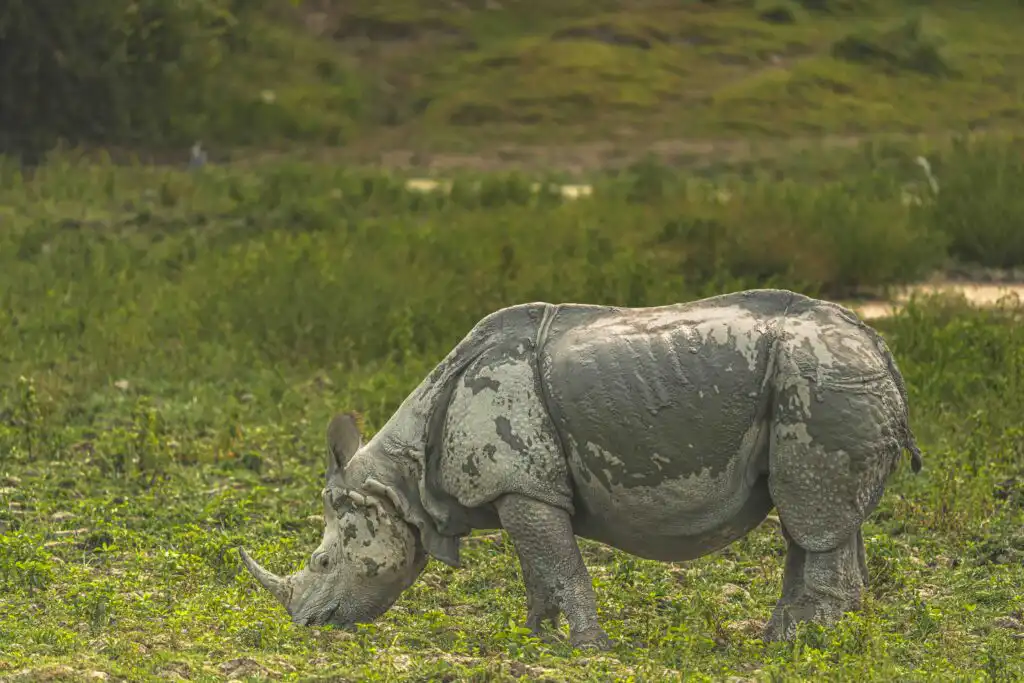
The rhino is a devoted grazer for the great majority of its diet. Elephant grass is one of the tall, nutrient-rich grasses that abound in its habitat in the alluvial floodplains. Indeed, these grasses make for as much as 80% of its diet.
Even though grass is the main food source, it actively adds other plants to its diet, particularly in the dry winter months when grasses are less nutrient-dense. Compared to many other large herbivores, it is therefore significantly more versatile.
It also eats leaves, tender shoots, from the low hanging branches, along with that they eat fruits and aquatic plants, both floating and submerged.
The Biology and Behavior of the Prehistoric Titan
Size and weight: An adult male can weigh more than 2 tonnes weight ranging from 2.2 tonnes to 2.7 tonnes which is approx ( 2,200- 2,700 kg) and can be as tall as 2 metres at the shoulder , females are just a little bit smaller than the males, otherwise, still a formidable size.
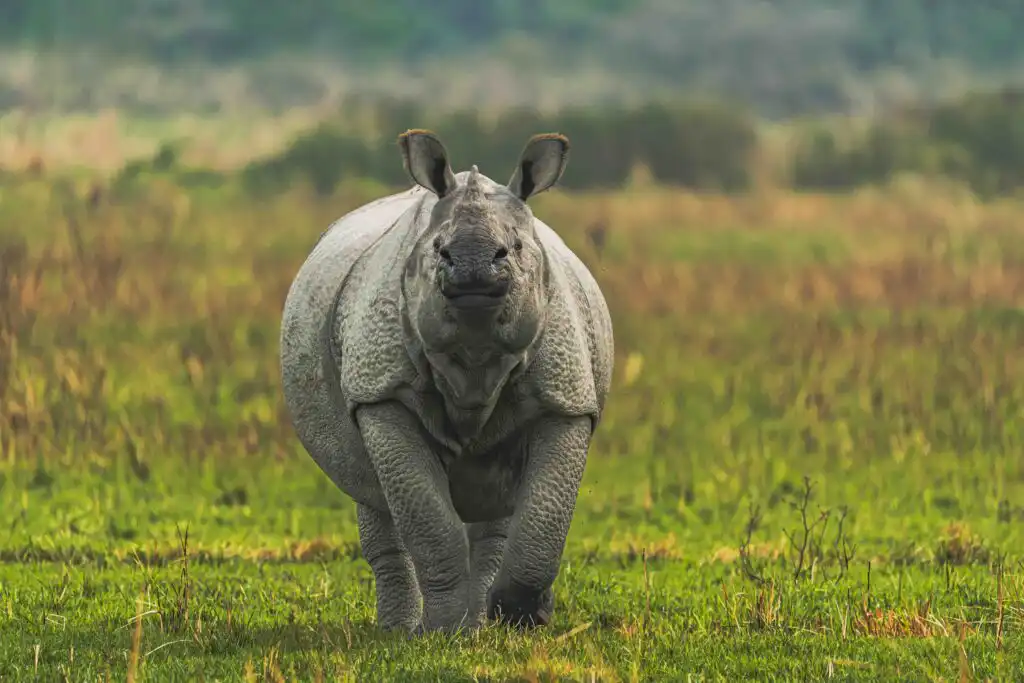
The armour: The skin of the greater one horned rhino can be as thick as 4 cm, the skin is arranged in the massive, shield like folds, which gives it a plated armoured appearance, this formation of the skin protects the animal from the sharp grasses, and the tusks of the rival horns. Although it has a very tough exterior , the skin of the rhino is quite sensitive to sunburn, insect bites etc.
The Prehensile Upper Lip: Unlike the square lips of white rhinos which are adapted for grazing or the hooked lips of black rhinos for browsing, the Indian rhino has a semi-prehensile, pointed upper lip. This is a unique tool for grasping tall grasses, pulling up aquatic vegetation, and browsing on leaves and shrubs, which reflects a more generalist diet that was important for survival.
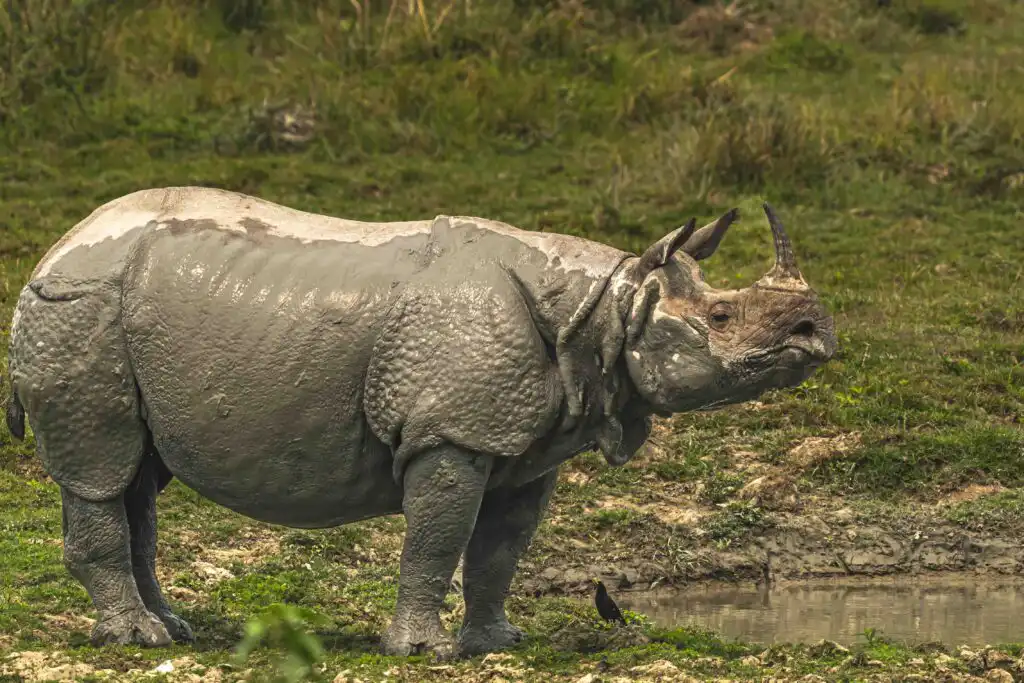
Mud wallowing: wallowing in the mud is not a luxury but it is done out of necessity. The mud acts as the sunscreen, which helps regulate their body temperature by keeping them cool, protecting the skin from insect bites and parasites as well, it is important to know that these wallows are so regularly used that they become a permanent part of the landscape.
Social structure: These are usually very solitary animals, except for the mother with their calves and during breeding season, Males are extremely territorial and mark their territory with urine , dung piles and scraping their feet on the ground. These dung piles also called middens are important for communication, conveying information about the rhino’s sex, reproductive status etc.
Reproduction and lifespan: A single Rhino calf is born after the gestation period of 15 to 16 months, the mothers are usually very protective of their calves , the calf will stay with the mother for over 2 to 3 years. In the wild the Greater One horned Rhino can live for around 35-45 years.
Also Read: Siberian Tiger vs Bengal Tiger: Which predator reigns the wild?
What Makes It a Unicorn?
The most distinguishing feature of this animal is its single, black long, horn which is not made of bone but keratin, it is the same protein that makes up our hair and fingernails, the length that the horn can grow up to is around 60 cm which would be 24 inches, this horn is used for the defence, intimidation and also guiding the young ones.
Did the Greater One Horned Rhinoceros Face Extinction?
Even though the Greater One-Horned Rhinoceros is a potent sign of tenacity, it is still in danger of going extinct due to serious threats. Even though conservation efforts have been remarkably successful, the species is still at risk from a combination of new environmental issues and ongoing pressures brought on by humans.
Poaching
The biggest threat to the species is still the illegal demand for rhino horn. In East and Southeast Asian black markets, rhino horn is highly prized due to theories that keratin, the same material that makes up human hair and nails, has therapeutic qualities and cures infertility, many think it also serves as aphrodisiac
The lives of rhinos,forest guards and other biodiversity are at risk due to poachers, who are frequently armed and well organized. Poaching is and has been a serious threat to the future of the species because, in spite of strict protective measures, the profitable trade encourages the greedy hunting.
Habitat loss and Fragmentation:
In addition to being essential for rhino survival, the floodplains and grasslands are ideal for human use. Agriculture, urbanization, and infrastructure development have drastically reduced and fragmented their habitats. This kind of invasion isolates rhino communities, decreasing genetic diversity and increasing the risk of inbreeding. Along with that it pushes rhinos into human dominated areas, leading to conflicts that are harmful to both people and animals.
Wildlife-Human Conflict
Human-rhino negative interactions are inevitable as rhino habitats diminish. When rhinos invade agricultural areas, they raid crops, costing local populations money. Farmers may hurt the animals in retaliation, starting a violent circle of conflict that puts both people and rhinos in danger.
It’s still difficult to strike a balance between protecting animals and meeting human needs, but conservationists are working relentlessly to solve this issue.
Climate Change
The consequences of climate change are posing a growing threat to rhino habitat. Extreme droughts and severe monsoon floods are examples of harsh and unexpected weather phenomena that break the delicate balance of their ecosystem.
While floods can drown rhinos and destroy their food supplies, droughts restrict the amount of water and grazing land accessible to rhinos. These changes put the entire ecosystem that rhinos support in jeopardy.
Also Read: Crocodiles in India
The Comeback of the Titan From the Brink of Extinction
Many people consider the Greater One-Horned Rhinoceros comeback to be among the top most successful conservation efforts in history. Through unrelenting work, strategic research, and deep cooperation, this ancient giant has been rescued from the brink of extinction.
The rescue efforts started when “conservation” was still a relatively new idea in the field . The story is said to start with Mary Curzon, the Baroness of Kedleston. She was surprised to see that rhinos were being hunted to extinction after traveling to Assam in 1904 and not seeing a single one.
The key push was her lobbying with her husband, Lord Curzon, the Viceroy of India. Her enthusiasm was the driving force behind the first protective measures for this titan.
The Beginning :
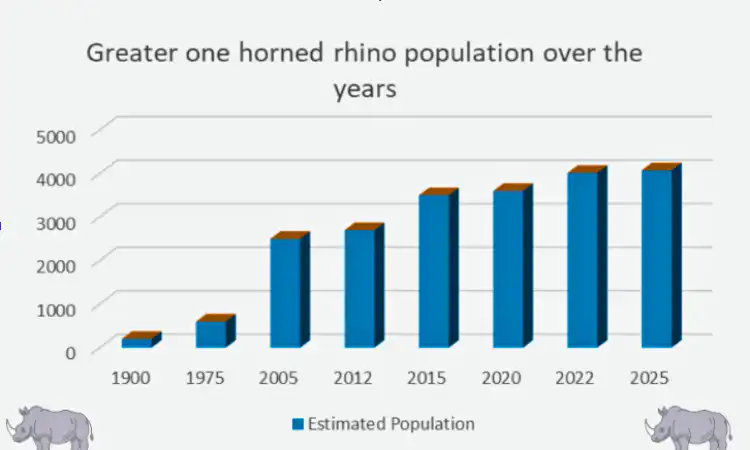
By the early 1900s, things had gotten really bad. The global population was down to less than mere 200 individuals due to widespread hunting, shooting for sport and horn and rapid habitat destruction. These final survivors were dispersed throughout Assam and Nepal in tiny, remote areas. In the majority of its historical range, the species was functionally extinct. The government took bold action to start the turnaround
The Lifeline :
It was renamed a game sanctuary in 1916 and then a wildlife sanctuary in 1950.
The Wildlife Protection Act, passed by India , by 1975, outlawed all hunting and gave the species complete legal protection.
Formally created National Parks and Reserves offer secure, untouchable areas to these animals
Anti-Poaching:
In order to implement a zero-tolerance policy, Fortress Conservation used armed guards, anti-poaching camps, and shoot-to-kill procedures. For additional security, they also included contemporary technology like drones and night vision. Secure zones established by this militaristic strategy were essential to the rhino’s recuperation.
Habitat Restoration
To maintain the rhino’s habitat, the restoration included several invasive species removal, waterhole management, and controlled grassland burning and several other initiatives. These initiatives were essential for providing food, water, and suitable living conditions for the expanding population
Translocation:
In order to create new populations with new genome sequences and lessen habitat pressure, the translocation project relocated rhinos from high density areas to historic ranges where the population thrived. To ensure genetic variety and long-term recovery of the species , this thought provoking operation required skilled collaboration in order to securely sedate, transport, and release these giants.
Also Read: Top 10 venomous snakes in India
Result - A Successful Milestone:
The numbers plummeted from mere 200 individuals to more than 4000 within a century , thanks to conservation efforts.
Best Places to See Greater One Horned Rhinos:
The highest chance to see these prehistoric titans are as follows:
1.Kaziranga National Park, Assam, India– This beauty holds around 2,600 rhinos, which is equivalent to more than two thirds of the world’s population. The park is also a UNESCO world heritage site and hosts incredible biodiversity which also includes apex predators like tigers as well.
Also, know about the best safari zones in Kaziranga National Park.
2. Chitwan National Park: The cornerstone of Nepal’s rhino conservation, Chitwan hosts the second largest population constituting 600 rhinos.
3. Pobitora Wildlife Sanctuary, Assam : It has the world highest density for these rhinos , although the area is small it provides an excellent chance of seeing the species.
4. Orang National park, Assam: It is known as “ Mini Kaziranga” offering the lesser explored areas of the landscape.
To experience these parks firsthand, join our North East India Wildlife Tour, a 10-night/11-day journey through Kaziranga and the misty forests of Singalila National Park, offering sightings of both Rhinos and Red Pandas.
Final Thoughts on Rhino
As the mists continue to rise over the grasslands , the fate of this armoured prehistoric giant rests in our hands. It is our collective duty and responsibility to ensure that this magnificent and beautiful chapter of India’s natural heritage is not closed, but continues to be written for the next generations to come.
Plan Your Wildlife Tour in India with Us
If reading about the Greater One-Horned Rhino has inspired you to explore India’s wilderness, we invite you to journey with us. At Pugdundee Safaris, we design experiences that bring you closer to nature while ensuring comfort and warm hospitality at every step.
Explore our tours:
📞 +91-011-40132680 | 📧 enquiry@pugdundeesafaris.com
Shaik Shaheen, Naturalist at Pugdundee Safaris
About the Authour: She majored in Master’s in wildlife conservation from Pune in 2021. Having lived in the city her entire life, she would always find her escape in the outskirts of the city of Hyderabad, and she was effortlessly drawn towards wildlife as a career. While she was pursuing her bachelor’s in Genetics and Microbiology, she worked at Hyderabad zoo as a volunteer on the weekends.