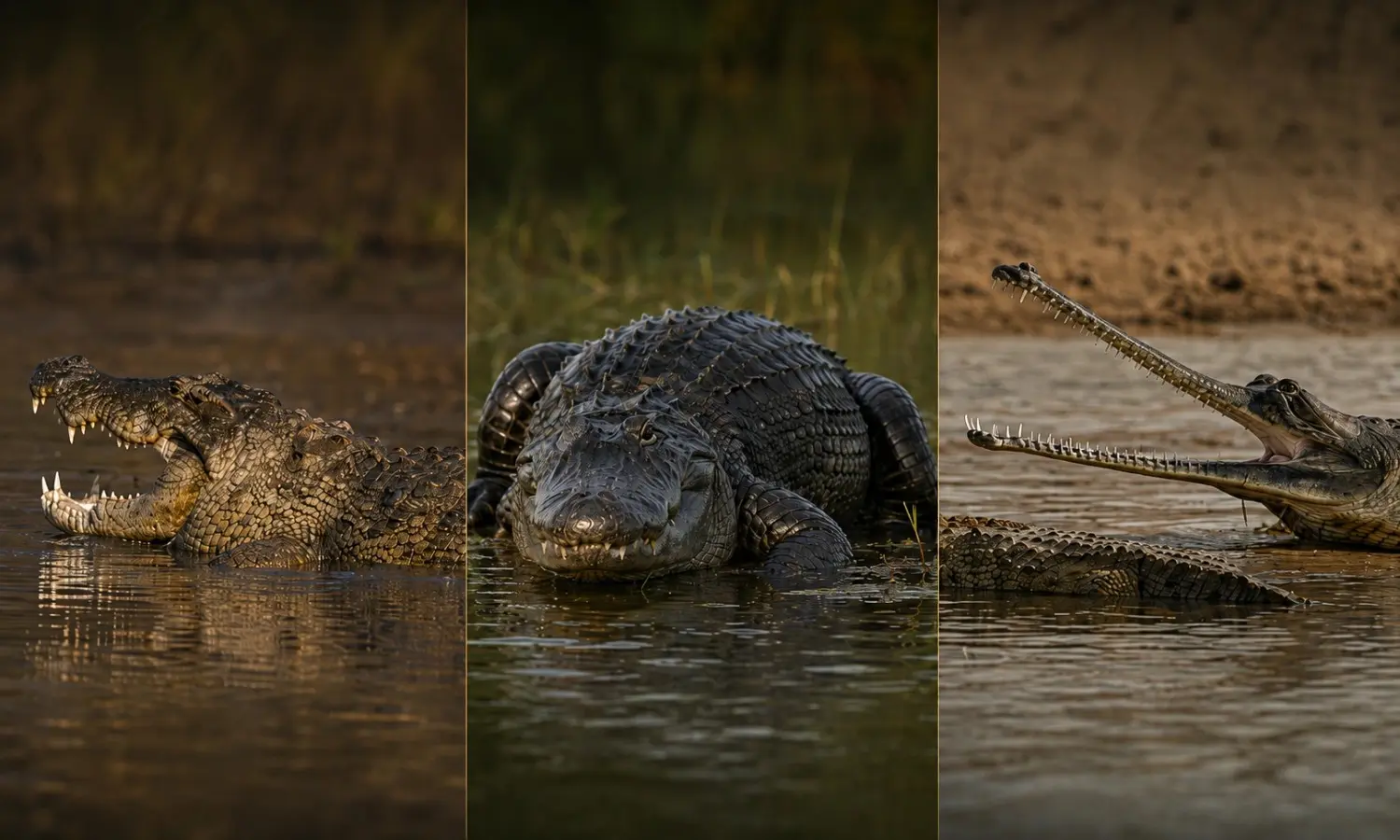
Comparison of crocodile alligator and gharial snout shapes

Crocodile vs Alligator vs Gharial: What’s the Difference?

To the untrained eye, crocodiles, alligators and gharials look remarkably alike. They all belong to the ancient order Crocodylia, sharing an evolutionary history that stretches back over 200 million years. These semi-aquatic stealth hunters look heavily armoured with tough, scaly skin. Their physiology is roughly the same, consisting of a lizard-like body with an elongated snout and tail flattened sideways. As cold-blooded reptiles, they enjoy basking in the sun by riverbanks to regulate their body temperature. 

Look a little closer, however, and differences begin to emerge. From the shape of the snout and the arrangement of the teeth to their build, preferred habitats, diet and hunting styles, each has evolved to thrive in a different ecological niche. 

If you’ve ever wondered how crocodiles vs alligators vs gharials compare, this guide breaks down the key differences between the three for easy identification.

Table of Contents
    Add a header to begin generating the table of contents

    Distribution and Habitat: Crocodile vs Alligator vs Gharial:

    Although they share a common ancestry, crocodilians have conquered remarkably different corners of the world as apex predators of varied ecosystems.
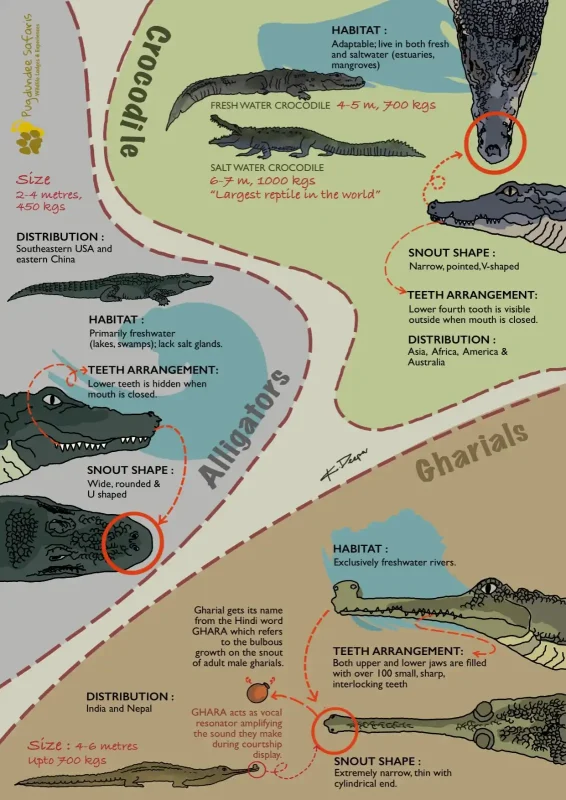
    Infographic showing the differences between crocodile, alligator and gharial

    Crocodiles:

    Crocodiles are spread across Asia, Africa, the Americas and Australia. They’ve adapted to an impressive range of habitats, from freshwater rivers and lakes to mangrove forests, estuaries and even coastal seas. Some, like the saltwater crocodile (the largest reptile alive) regularly venture into the open ocean. 

    Alligators:

    Alligators are primarily found in Southeastern USA and eastern China. Lacking salt glands present in crocodiles and gharials, they occupy freshwater ecosystems like swamps, marshes, rivers and lakes. Caimans, generally considered the smaller relatives of alligators, inhabit the rivers, wetlands and flooded forests around Central and South America. Many species have a more heavily armoured body, with bony plates extending across the belly.

    Gharials:

    Gharials are endemic to the Indian subcontinent, now only found in India and Nepal. A majority of this species is concentrated in the Chambal river which stretches across the states of Madhya Pradesh, Uttar Pradesh and Rajasthan. Gharials are Critically Endangered; 98% of the population has declined in the last century, and they are now present in only 6% of their original range, which stretched across Bhutan, Pakistan and Bangladesh previously. They survive today in a handful of freshwater, fast-flowing, perennial river systems with deep pools and large sandbars. 

    These differences are a fascinating lesson in how ecology and evolution have shaped form and function across around two dozen species found across the globe, grouped into three families: Alligatoridae (alligators and caimans), Crocodylidae (true crocodiles), and Gavialidae (gharials and the false gharial). 

    India is also home to mugger crocodiles and saltwater crocodiles, each adapted to different freshwater, wetland and coastal habitats. Learn more about the different crocodiles in India, their distribution, behaviour and conservation status.

    Also Read: Life Cycle of Tiger

    How to Tell Crocodile vs Alligator vs Gharial Apart through Physical Characteristics

    If you lined these evolutionarily distant cousins up for a family portrait, you could tell them apart by a few distinctive physical features, starting with the face and body build. 

    Crocodiles:

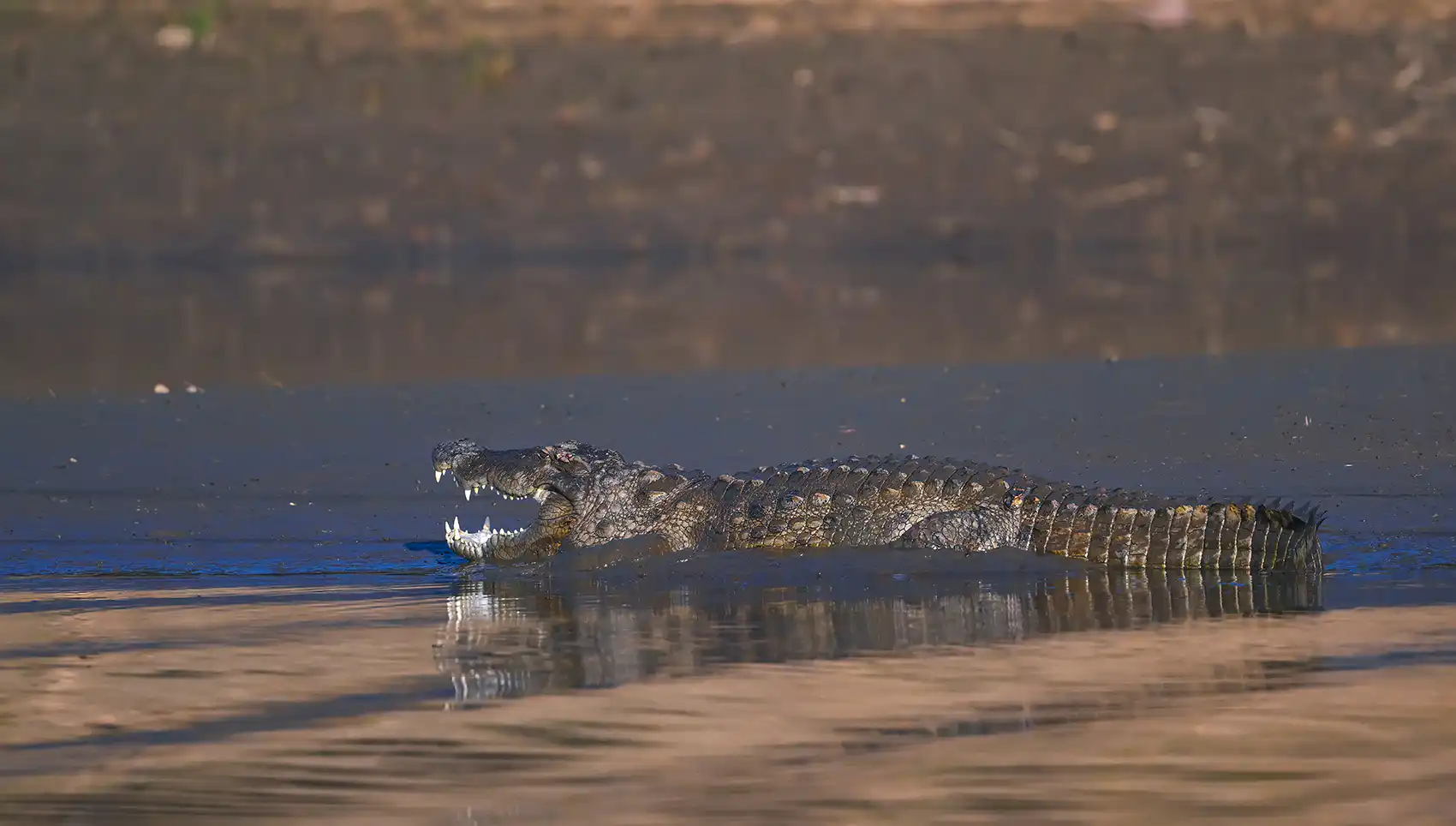
    Crocodiles, belonging to the Crocodylidae family, have the confident grin of a predator that isn’t particularly fussy. As apex predators that hunt on land and in water, their long, V-shaped snout tapers to a point, allowing it to tackle everything from fish and birds to deer – a diverse diet indeed! Its upper and lower jaws are roughly the same width, resulting in a jagged, interlocking “toothy grin” where several lower teeth remain visible, especially the large fourth tooth jutting out at the bottom.

    Crocodiles are lean, muscular and built for versatility. Their bodies are relatively narrow, the limbs are strong enough to gallop short distances on land, and the tail provides explosive bursts of speed in water. Most species are lighter in colour, between an olive to grayish-green to tan.

    Crocodile in water showing its V-shaped snout and visible lower teeth

    Alligators:

    Alligators, belonging to the Alligatoridae family, have wide, rounded U-shaped snouts that give them a powerful bite suited for crushing turtles, molluscs and other hard-shelled prey. When they shut their mouths, most of their lower teeth are hidden neatly inside the upper jaw. They look stockier with broad bodies, powerful necks and heavily built heads. 

    Alligators are typically darker in colour, ranging from charcoal-gray to black, which helps them blend into the shadowy freshwater swamps and marshes they live in. They generally conserve energy, relying on short bursts of speed when needed. 
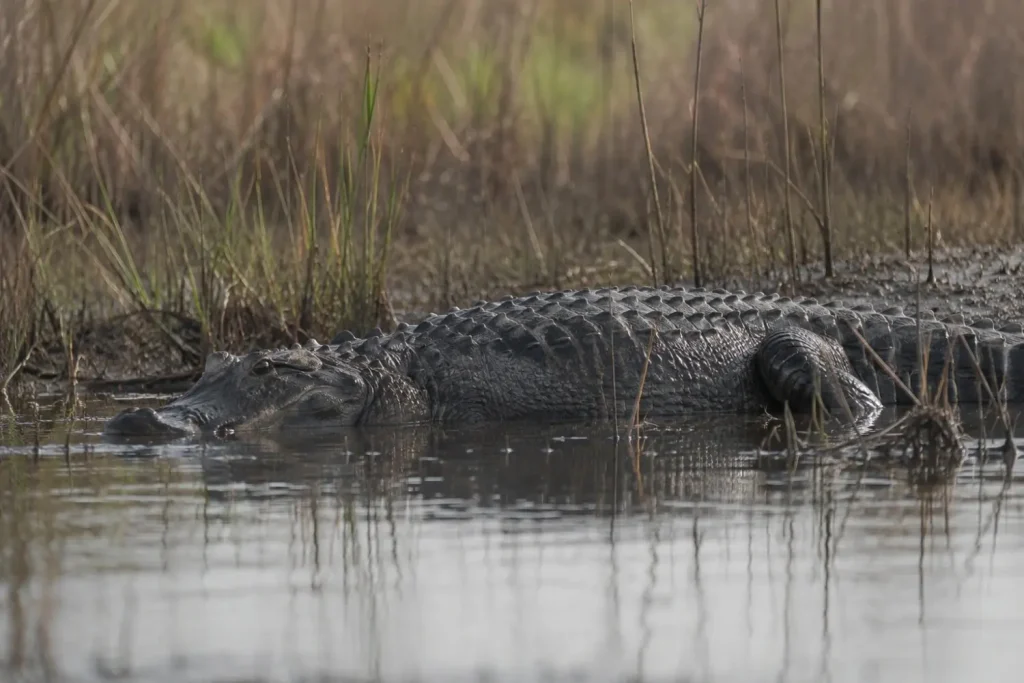
    American alligator in a freshwater marsh showing its broad U-shaped snout

    Gharial:

    In comparison, Gharials, part of the family Gavialidae, have long, pencil-thin snouts with sharp teeth built for one thing: catching fish in water since they are largely piscivorous. Adults can have over a hundred needle-like teeth, many visible even when the mouth is shut. 

    This is the only crocodile species where males and females exhibit sexual dimorphism. Mature males grow a bulbous knob at the tip of the snout, called a ghara, derived from the Hindi word for pot. This knob is used to produce resonant calls during mating and attract females. 
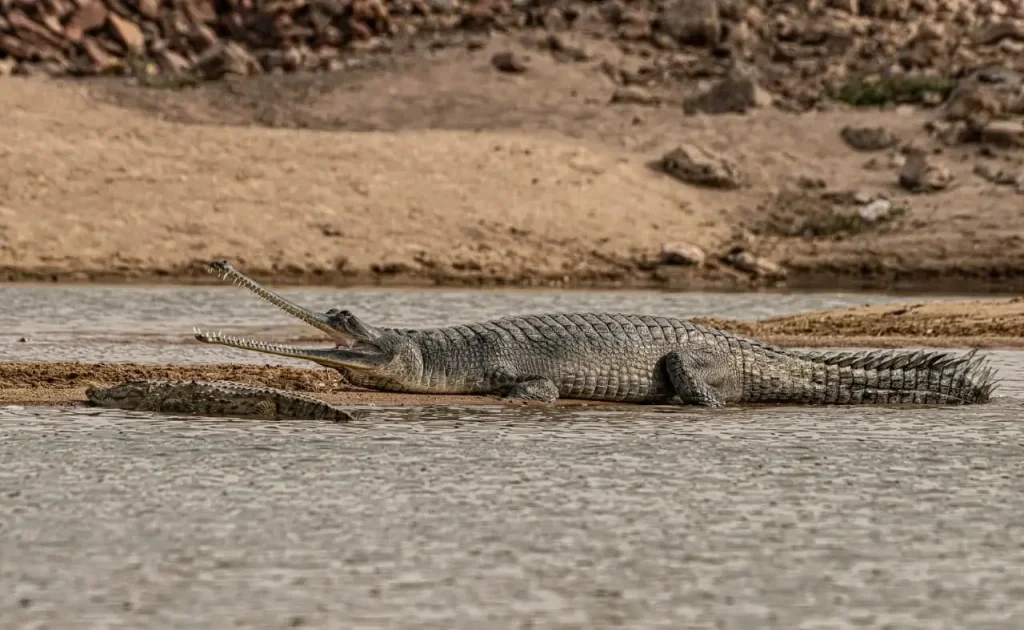
    Gharial resting in a river with its long narrow snout and needle-like teeth

    Their bodies are comparatively slender and streamlined, with shorter, weaker legs and a flattened, tall tail. While they are awkward on land and often drag their bellies, in water they transform into effortless swimmers thanks to their webbed feet and graceful sweeps of their tail, which they use to pursue and prey on fish with remarkable agility. 

    Also Read: Mongooses in India: The 6 Species and How to Identify Them

    The table below lists some more differences between crocodiles, alligators and gharials. 

    Characteristic Crocodile Alligator Gharial
    Maximum Length Males: 17 feet on average, although some males have been recorded up to 23 feet in length.

    Females: 8–10 feet on average
    Males: up to 15 feet

    Females: up to 9.8 feet
    Males: 10–15 feet, although some have reached lengths of up to 20 feet.

    Females: 8.5–15 feet
    Average and Maximum Weight (Males) 1,000 lb on average,
    up to 2,200 lb
    400–800 lb on average,
    up to 1,000 lb
    350–400 lb on average,
    up to 1,500 lb
    Bite Force The strongest measured bite force of any animal belongs to the saltwater crocodile, at up to 3,500 PSI. Up to 2,900 PSI 400–450 PSI
    Speed Up to 22–24 mph in water,
    11 mph on land
    Up to 20 mph in water,
    11–15 mph on land
    Up to 15 mph
    Average Adult Lifespan in the Wild 50–70 years
    In captivity, crocodiles have been observed to live for more than 100 years.
    30–50 years 40–60 years

    Based on the Saltwater Crocodile (Crocodylus porosus), the largest living crocodilian.

    Based on the American Alligator (Alligator mississippiensis), the larger of the two alligator species.

    Conclusion

    Crocodiles, alligators and gharials may appear similar at first, but their snout shape, teeth, body structure, habitat and diet make each one distinct. Crocodiles are versatile predators, alligators are freshwater specialists with broad snouts, while gharials are river-dwelling fish hunters adapted to life in water.

    Understanding these differences makes identification easier and also highlights why protecting their natural habitats is essential for their long-term survival.

    Understanding these differences makes it easier to identify crocodiles, alligators and gharials while also showing why wetlands and river ecosystems need protection. To experience India’s diverse wildlife in its natural habitat, plan a carefully curated Wildlife Safari in India with Pugdundee Safaris.

    Also Read: Praying Mantis in India: Facts, Life Cycle & Types

    FAQs:

    In India, we currently find three species of crocodiles - gharials, muggers (marsh crocodiles) and saltwater crocodiles. Mugger crocodiles are much more widespread while saltwater crocodiles are found along the eastern states of Orissa, West Bengal, Tamil Nadu and the Andaman and Nicobar Islands. 

    Some visual cues that can help with easy identification include:

    • V-shaped snout for crocodiles vs U-shaped snout for alligators
    • Visible fourth lower tooth in crocodiles
    • Crocodiles are generally lighter in colour, while alligators are darker
    • Habitat and geographical distribution (saltwater/brackish vs freshwater)

    The gharial is the most threatened of the three crocodilians, having suffered dramatic declines due to river modification, entanglement in fishing nets, sand mining and habitat loss. Conservation programmes in India and Nepal are helping populations recover.

    The saltwater crocodile has the strongest measured bite force of any living animal, at 3500 PSI (pounds per square inch). In contrast, humans have an average bite force of 162 PSI, which means this ambush predator is capable of exerting 22 times more force than a human bite.

    The differences in size depend on the species. Saltwater crocodiles are the largest living reptiles in the world. Gharials can reach up to 20 feet but are much slimmer in their build. American alligators are generally smaller and stockier than crocodiles at large, while caimans are much smaller than alligators.

    Gharials are sexually dimorphic. Mature males grow a bulbous, hollow knob at the tip of their snout, called a ghara, derived from the Hindi word for earthen pot. This knob serves a socio-sexual function: it is used to produce and amplify vocalizations during mating and attract females.

    The only place where crocodiles and alligators are found in the same ecosystem is in the Florida Everglades in the southeastern United States. The American crocodile prefers saltwater, sticking to coastal bays, lagoons and mangrove swamps, while the American alligator favours freshwater, dominating freshwater rivers, ponds, and marshes. Protecting their natural habitats and avoiding products made from animal hair can support their conservation.

    Gharials (Gavialis gangeticus) are freshwater specialists endemic to the Indian subcontinent, while crocodiles inhabit a much wider range of freshwater, brackish and coastal ecosystems across the world. 


    Gharials have long, slender snouts with numerous sharp teeth and streamlined bodies that enable them to catch fish in fast-flowing rivers, being entirely piscivorous. Adult male gharials have a distinctive appearance due to a bulbous growth at the tip of their snout called a ghara. Meanwhile, crocodiles have a broader, V-shaped snout with a toothy grin; they hunt and feed on a variety of prey from fish to birds and mammals. They have adapted to live on both land and water, while gharials spend most of their time in the water. 

    About the Author

    Pooja is a nature and wildlife enthusiast who finds joy in exploring the wilderness, whether on safari in the forests or hiking in the hills. As a content writer with Pugdundee Safaris, she draws inspiration from nature to craft stories and poetry that connect the human experience with the beauty of the natural world. Through her writing, she hopes to inspire and educate others about the wonders of wildlife and conservation.