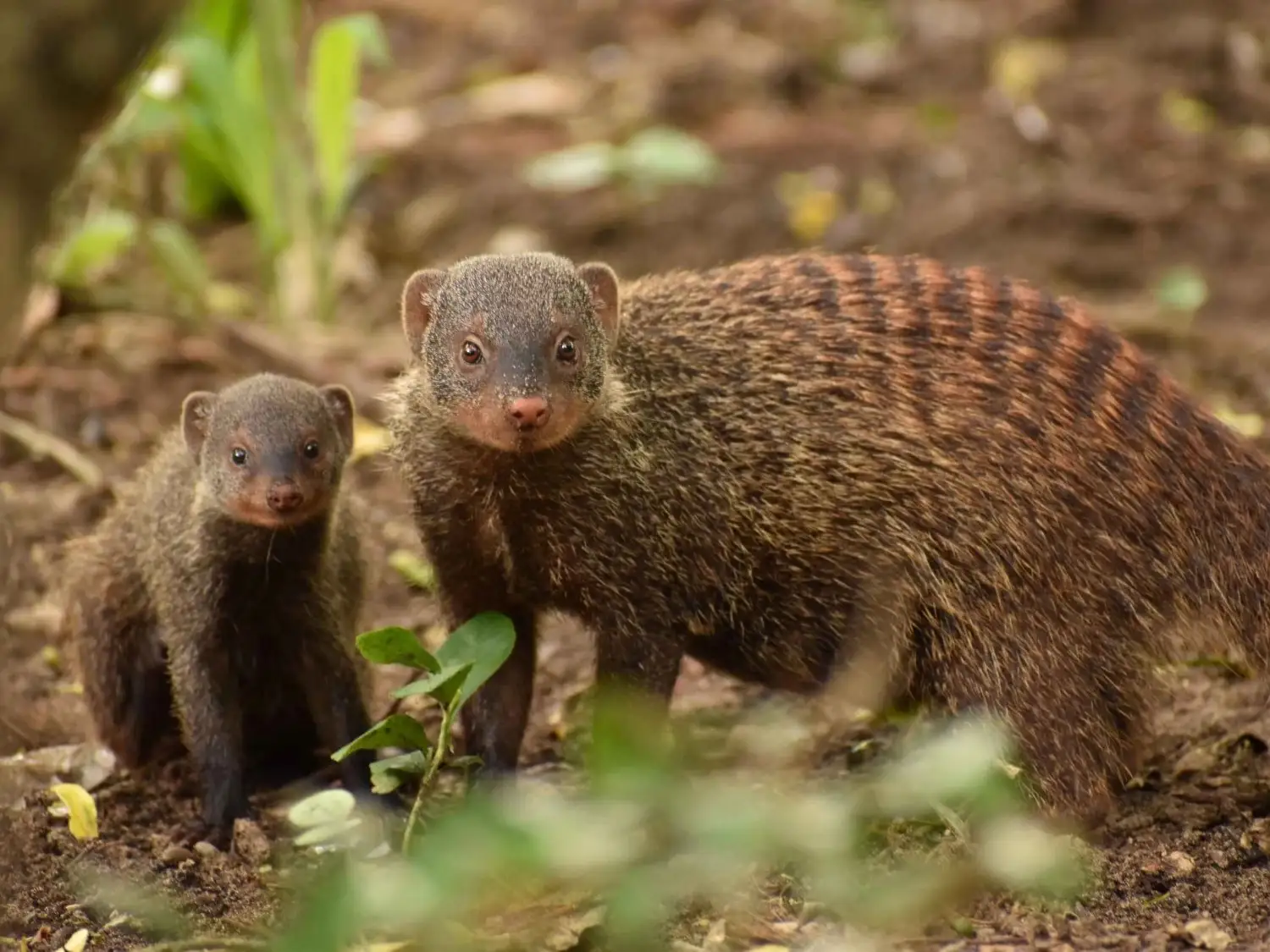
Most of us first met them through Kipling’s Rikki-Tikki-Tavi, but India’s real world mongooses are far more interesting than fiction.
India is home to six species of mongooses. These Mongooses are found in various habitats ranging from dense tropical rainforests to arid scrublands and human settlements. The species found in India are Indian Grey Mongoose, Ruddy Mongoose, Indian Brown Mongoose, Small Indian Mongoose , Crab eating Mongoose and Stripe necked Mongoose.
Mongooses belong to the family Herpestidae. They are stealthy, graceful and fierce carnivores known for their ability to kill snakes, even venomous ones. They have long slender bodies, bushy tails, shortened muzzles and small erect ears, and are diurnal..
How is a Mongoose Different from a Civet?
Mongooses and civets are often confused with each other because of their similar appearance, but scientifically, they are very different from one another. Let us find out what makes them different.
| Mongooses | Civets |
|---|---|
| They belong to the family Herpestidae. | They belong to the family Viverridae. |
| Their appearance is more weasel-like, with a short, pointed snout and a long body. | Their appearance is more cat-like, with larger eyes and more prominent fur patterns. |
| They are typically diurnal in nature. | They are typically nocturnal in nature. |
| Mongooses are opportunistic carnivores and may eat snakes, insects, birds and other small animals. | Civets are omnivores and consume fruits, insects, small birds and other available food. |
Mongoose species of India (Comparison Table)
| Species | IUCN Status | Weight | Body Length | Key Marker | Best Seen |
|---|---|---|---|---|---|
| Indian Grey Mongoose (Urva edwardsii) | Least Concern | 1.4 kg | 36–45 cm | Pale tip of the tail | Throughout Indian villages and along the edges of towns |
| Ruddy Mongoose (Urva smithii) | Least Concern | 2–3 kg | 39–45 cm | Black tip of the tail | Tadoba National Park, Maharashtra, and Daroji Wildlife Sanctuary, Karnataka |
| Indian Brown Mongoose (Urva fusca) | Least Concern | 1.5–2.4 kg | 35–38 cm | Chocolate-brown fur and a bushy tail | Anamalais, Tamil Nadu |
| Stripe-necked Mongoose (Urva vitticollis) | Least Concern | 3.1 kg | 40–50 cm | Black stripe extending from the ear to the shoulder | Nagarhole National Park, Karnataka, and Anamalai Wildlife Sanctuary, Tamil Nadu |
| Crab-eating Mongoose (Urva urva) | Least Concern | 1.3–2.4 kg | 45–50 cm | White stripe extending from the cheek towards the back | Manas National Park, Assam |
| Small Indian Mongoose (Urva auropunctata) | Least Concern | 0.5–1 kg | 25–35 cm | Olive-brown fur with golden speckles | Keoladeo Ghana National Park, Rajasthan, and Panna Tiger Reserve, Madhya Pradesh |
The Venom Vendetta: Cobra vs Mongoose
(Mongoose vs Snake: Why Mongooses Can Fight Cobras)
While popular folklore attributes the mongoose as a venom-immune superhero, the reality lies in physics and neurology. In India’s scrublands, a legendary showdown unfolds between the slithering and the furry-ous.
The iconic showdown begins in the form of a dance battle where the mongoose intentionally provoke strikes the serpent using a strategy of attrition, constantly dancing around the snake, feinting, and forcing the reptile to strike repeatedly until it is physically exhausted. If eventually the snake is able to land a bite to the mongoose, it is immediately encountered by its physical defenses.
A cobra striking a mongoose, injects the mongoose with enough neurotoxin to kill a human, yet the tiny mammal brushes it off. Its success relies on agility, armor, and a biochemical trump card.
Mongooses use their agility to tire out the snake, whilst their thick, coarse fur protects them from the initial bites. During a fight, a mongoose will puff up this fur to make itself look larger. Thus when a snake strikes, what it encounters is a just mouthful of fur and not the flesh, as was intended.
But, one of the mongoose’s most strongest suits is that which cannot be seen by the naked eye. The mongoose’s possesses mutated acetylcholine receptors present in its nerve cells, which prevents the venom from binding to the mongoose’s nervous system.
Eventually, the snake tires out. The mongoose seizes the opportunity to deliver a fatal blow on the back of the snakes head, severing either the skull or the spinal cord.
However, they are not completely invincible. If the snake is big enough and can produce and inject enough venom into the furry mammal, it could definitely kill the mongoose. Mongooses are not much immune to haemotoxin, meaning a massive dose or a strike from a viper might still be fatal.
The Indian gray mongoose( immortalized as ‘Rikki-Tikki-Tavi, by Rudyard Kipling) is one of the most well-known snake killers, known for taking on the king cobra, one of the deadliest snakes in the world. These mongooses hunt and kill these snakes in their natural habitat, eating them all the way to the venom sacs.
In the agricultural ecosystems and rural landscapes of central India, these two predators maintain an essential ecological balance. While mongooses keep venomous snake populations in check, the snakes help regulate rodents and smaller prey.
India is home to several highly venomous snake species beyond cobras. Explore our guide to the top 10 venomous snakes in India to learn about their identifying features, habitats and venom types.
The science behind it-
Cobras and many other venomous snakes rely on alpha-neurotoxins. In most animals, these toxins bind to acetylcholine receptors in muscle cells, blocking nerve signals and causing rapid paralysis and death.
Mongooses have evolved a specific genetic mutation that slightly alters the shape of their acetylcholine receptors. The snake’s neurotoxin acts like a key trying to fit into a lock, but the mongoose’s lock is just different enough that the key will not turn.
The venom fails to bind to the receptors, making the mongoose highly resistant to doses of neurotoxin that would easily kill much larger mammals.
Six Mongoose Species of INDIA
1. Indian Grey Mongoose (Urva edwardsii)
Indian grey mongoose is best identified by its tawny grey fur and pale tipped tail and much grizzled appearance. It is this species that is famously known for tackling venomous snakes.
IUCN- Least Concern
Habitat and Distribution-
Indian Grey Mongooses inhabit open scrub, cultivated land, rocky patches, dry forests and forest edges all over India. They are found across a wide range throughout India, Pakistan, Nepal, Sri Lanka, Bangladesh and Bhutan and occupy areas of Arabia and Iran. Except the high Himalayas (only up to 2100m).
Best seen– Throughout Indian villages and edges of towns.
India’s wildlife diversity also includes several remarkable large carnivores; readers can explore our guide to the different species of cheetah and learn more about their characteristics and habitats.
2. Ruddy Mongoose (Urva smithii)
The ruddy mongoose is perhaps the most commonly encountered mongooses in Central Indian jungles. This large forest mongoose differs from the grey mongoose (Urva edwardsii) in its reddish brown coat and characteristic black tipped tail which is always holds higher than its body. It has partially webbed feet.
IUCN- Least concern.
Habitat and Distribution-
The Ruddy Mongoose primarily ranges across the pristine forests of central, western and peninsular India. Characterized by its elusive nature, it prefers undisturbed and secluded areas in dry deciduous and thorny forests.
Best seen- Tadoba National Park, Maharashtra and Daroji wildlife sanctuary, Karnataka
3. Indian Brown Mongoose (Urva fusca)
This sylvan carnivore is known to be much more secretive than its cousins thus very little is known of them, it gets its name from its coarse dark brown fur that partially covers its feet. Another characteristic feature of this mongoose is its bushy tail which is two thirds of its body length and tapers conically towards tip.
IUCN- Least concern.
Habitat and Distribution-
This mongoose is found in parts of the western Ghats including the Nilgiris, Palani hills, Anamalai hills, high wavy mountains of Madurai etc. It prefers moist deciduous and evergreen forests including coffee plantations.
Best seen- Anamalais, Tamil Nadu.


4. Stripe necked Mongoose (Urva vitticollis)
The stripe necked mongoose is the largest mongoose of Asia. Males can weigh up to 3.1 kg. The species is most reliably identified by its striking namesake feature: a bold black stripe thinly bordered with white, which runs from its ear to shoulder on both sides of the neck. Its robust body is covered in a dark grizzled gray fur with reddish tints.
IUCN- Least concern.
Habitat and distribution-
Primarily native to Western Ghats and Sri Lanka. In India, its range extends along mountain ranges through the states of Kerala, Karnataka, Goa and Maharashtra.
These mongooses can be found in a wide range of habitats including deciduous forests, both dry and moist and evergreen forests, plantations and scrub, swampy areas and even hilly country.
Best Seen– Nagarhole National Park – Karnataka, Anamalai Wildlife Sanctuary – Tamil nadu.
5. Crab Eating Mongoose (Urva urva)
This aquatic mongoose is slightly smaller than its cousin from Southern India – the Stripe necked mongoose. This mongoose has a unique broad white stripe that runs from its cheeks to parts of its back, accompanied by grey to dark brown fur, which gives it a grizzled appearance. To aid its aquatic lifestyle and preference for making a meal of fish, crab, snails and frogs, its feet have a shallow webbing.
IUCN- Least concern
Habitat and Distribution-
Their home range covers a wide area including north-eastern India and southeast Asia.
These mongooses are deeply tied to aquatic environments i.e. they are mainly found near water, such as stream banks, paddy fields and moist deciduous forests.
Best Seen- Manas National Park, Assam.
India’s rivers, wetlands and forest streams are also home to several reptile species; discover more about the different crocodiles in India, their habitats and conservation status.
6. Small Indian Mongoose (Urva auropunctata)
This is the smallest mongoose of India weighing up to only 1 kg. It differs from its larger cousins in that it has short silken olive-brown or dark brown fur interspersed with golden speckles. This mongoose species displays various forms of vocalisations including a weep, squawk, honk, pant, bark, chuck, scream and growl.
IUCN- Least Concern.
Habitat and Distribution-
The natural range of the small Indian mongoose spans vast expanses of land – from fertile plains of the Indo-gangetic river system to central Indian forests. It prefers open scrub forests, hedges, farms, deserts and even human habitation.
Best seen- Keoladeo Ghana National Park, Rajasthan , Panna Tiger reserve, Madhya Pradesh.
Mating and Reproduction
Mongooses exhibit fascinating, though rarely witnessed, reproductive behaviours. Typically solitary and highly territorial these carnivores transition into a polygynous mating system multiple times a year.
Courtship begins with males scent marking to advertise their presence to potential mates. Once a mate is found, vocalisations such as- high pitched “giggling” is observed, in addition to other courtship displays such as biting, leaping and even play fighting.
Following a successful mating, the female faces a gestation period of approximately 42 to 80 days entirely on her own. Securely hidden in a rock crevice or a den or burrow, the female will give birth to up to 6 pups.
These young are born blind and are solely dependent on the female for maternal care for up to 6 months, wherein she probably suckles them.
Threats to Conservation
Mongooses hold a special place in India’s natural and cultural landscape symbolising agility, courage and resilience. These small carnivores are admired throughout the country for their fearless nature and ability to tackle venomous snakes. Their presence around villages, farmlands and forests is traditionally regarded as beneficial, as they help control rodents and snakes.
Their adaptability allows them to thrive in diverse habitats like forests, agricultural lands, scrub forests to wetlands. Despite the adaptability mongooses face severe threats from habitat destruction, road kills, illegal trade and declining prey availability.
Similar habitat and conservation pressures also affect aquatic mammals, including the three species of otters in India that depend on healthy rivers, wetlands and forest ecosystems.
Brushed to death...
Many mongooses are slaughtered every year to satisfy the demands of the world’s paintbrush industry. Mongoose guard hairs are coarse, springy and retain paint well. This makes it highly sought after by artists worldwide. This trade is brutally destructive. 1 mongoose yields only 40 gms of hair out of which 20 gm is usable after sorting. Thus, 50 mongooses are to be killed to produce 1 kg of hair.
Despite the ban for mongoose hair trade in India being enforced far back in 1972, the poaching and black market trade continues on. All 6 Mongoose species found in India are protected under Schedule 1 of the Wildlife Protection Act of 1972, which sets a three-year minimum sentence and a fine of 10,000 rupees (U.S. $146) for anyone convicted of killing, possessing, or trading a mongoose or its parts. Yet the slaughter persists, data from the non- profit Wildlife Trust Of India shows during the early 2000s some 50,000 mongooses were being killed annually to feed this black market.
The hunting itself is a brutal business, poachers use snares and nets to trap the animals before beating them to death, peeling off the fur, keeping the meat to themselves. Since Mongoose hair trade is not globally recognised as a major wildlife crime, there is little willingness and awareness of custom officials to go through the process of identification.
To battle the identification crisis ZSI ( Zoological survey of India) has developed a tricho-taxonomic system, that helps to identify mongoose hair based on the microscopic and macroscopic characteristics of the hair providing a vital tool for law enforcement.
However, science alone cannot solve a crisis driven by consumer demand. Newer generation of artists worldwide are now recognising the need to reject illegal animal hair brushes and are opting for high quality synthetic alternatives. India’s Mongooses belong to the scrublands, not trapped in the bristles of a paintbrush.
Conclusion
India’s six mongoose species highlight the remarkable diversity of the country’s wildlife. From the snake-fighting Indian grey mongoose to the aquatic crab-eating mongoose, each species has unique features, habitats and behaviours that make it fascinating to observe.
For nature and wildlife enthusiasts seeking a deeper understanding of India’s forests, Pugdundee Safaris offers expertly curated wildlife tours in India. Supported by experienced naturalists, extensive knowledge of local ecosystems and a strong commitment to responsible tourism, these journeys help guests discover both iconic animals and lesser-known species such as mongooses, birds and other forest wildlife.
FAQs:
India is home to six mongoose species: the Indian grey mongoose, ruddy mongoose, Indian brown mongoose, stripe-necked mongoose, crab-eating mongoose and small Indian mongoose.
The Indian grey mongoose (Urva edwardsii) is one of the most commonly seen mongoose species in India. It is widely found around villages, agricultural fields, scrublands, rocky areas and the edges of towns.
The stripe-necked mongoose (Urva vitticollis) is the largest mongoose species found in India and one of the largest in Asia. Adult males can weigh up to approximately 3.1 kg.
The small Indian mongoose (Urva auropunctata) is the smallest mongoose species found in India. It generally weighs between 0.5 and 1 kg and can be identified by its olive-brown fur with golden speckles.
Mongooses are opportunistic feeders that primarily eat insects, rodents, reptiles, frogs, birds, eggs and other small animals. Depending on the species and available food, they may also consume fruits and other plant matter.
No, mongooses are not completely immune to snake venom. They have specialised acetylcholine receptors that make them highly resistant to certain neurotoxins, but a powerful bite, a large dose of venom or venom from some snake species can still injure or kill them.
The major threats to mongooses in India include habitat destruction, road accidents, declining prey availability, poaching and the illegal trade in mongoose hair. Protecting their natural habitats and avoiding products made from animal hair can support their conservation.
Most mongoose species found in India are primarily diurnal, meaning they are active during the daytime. However, their activity patterns may vary depending on the species, habitat, weather and level of human disturbance.
Yes, a mongoose can kill a snake, including some venomous species. It relies on quick reflexes, agility, thick fur and resistance to certain neurotoxins, but fighting a venomous snake is still dangerous and the mongoose is not guaranteed to survive every encounter.

Mokshada Mahajan, Naturalist at Pench Tree Lodge, Pugdundee Safaris.
A PRONAT 2025 alumna, armed with a Master’s degree in Tourism and a childhood love for the wild, she loves translating the wonders of nature into unforgettable stories that help people reconnect and rediscover the magic of the wild that captured her own heart as a child.